

What Paragraph-Level Critique Catches That Sentence-Level Edits Miss

A paragraph can fail even if its sentences are sound. In this article, we look at what paragraph-level critique sees that a line-by-line pass cannot.
There is nothing wrong with a careful sentence-level pass. After all, the sentence is the building block of prose. If the actor is missing, if the verb is empty, if a modifier attaches to the wrong noun, the paragraph cannot save the sentence. That being said, readers do not experience a novel as a stack of isolated sentences. They experience it in blocks. The paragraph is the first unit in which those sentences have to work together.
Most writers notice the difference after a line edit. Each sentence has an actor. The verbs are doing work. The modifiers attach where they should. A grammar checker is quiet. The block on the page still feels crowded, or thin, or oddly weightless. The problem is no longer legality inside the line. It is context among the lines.
The previous article of this blog looked at what traditional grammar checkers miss at the sentence level. This one looks at the unit immediately above the sentence. In AI Book Editor, that unit is the paragraph—not the passage, not the chapter. Passage, chapter, and book notes exist as well, and they answer different questions. Paragraph-level critique asks what a group of sentences is doing as a single movement of attention.
This is not an argument against sentence-level work. It is an argument about why paragraphing is indispensable once the lines themselves are sound.

What a sentence can do, and what it cannot
A sentence has a spine: subject, verb, complement. Sentence-level critique is right to ask who acts, where the main verb sits, and whether the clause order serves emphasis. Those questions remain the foundation. A weak sentence will weaken every paragraph that contains it.
What a sentence cannot do on its own is govern the block. It cannot decide when the reader should be given a fresh start on the page. It cannot hear that four consecutive lines are making the same claim. It cannot see that a change of speaker, time, or focus has occurred without a break. Isolated grammar has no view of those relations. Needless to say, a line editor who never looks up from the sentence will leave them untouched.
Remember, the paragraph is how prose is chunked for the eye and for the mind. White space is not decoration. It tells the reader that one movement of thought has landed and that another is about to begin. When that signal is missing—or when it arrives too often—the page becomes either a wall or a scatter of fragments. Neither is a sentence problem.
Why the paragraph is better context than the sentence
Context, in this sense, is not a vague improvement. It is a wider window. A sentence-level note can tell you that a line is legal and even forceful. A paragraph-level note can tell you whether that force is in the right place in the block.
The first sentence of a paragraph takes off. The last sentence lands. What stands between them should develop a single movement—an action, a realization, a description that earns its length, a speech that belongs to one speaker. If the block contains two movements, the reader has to do the separating that the writer declined to do. If the block contains no movement at all, only restatement, the reader is given four versions of a thought that was finished in the first line.
That is why paragraph-level critique is better contextually than sentence-level critique for the problems that survive a line pass. The sentence is still the unit of grammar and local emphasis. The paragraph is the unit of attention. Until the writer can see the block as a block, a “clean” page will continue to feel unfinished.

The paragraph-level problems a sentence pass systematically misses
These failures can sit under a row of faultless sentences. They are common in drafts that have already been line-edited.
1. Four correct sentences that say the same thing
“Mara was tired. Exhaustion sat in her shoulders. She had not slept. The night had taken everything she had.” None of these lines is illegal. Together they are one claim, restated. A sentence-level pass may even praise the third line. Paragraph-level critique should ask which sentence is the spine of the block, and which three are decoration.
2. A change of focus with no break
A paragraph that begins on the kitchen table and ends in a childhood memory, without a turn the reader can see, is doing two jobs at once. The sentences may be individually sound. The block is not. New speaker, new time, new place, and new object of attention usually require a new paragraph. When they do not get one, the reader has to reorient in the middle of a sentence-string that looked continuous.
3. The turn buried in the middle
A paragraph of preparation, then the decision, then more preparation, leaves the change where the eye does not expect it. The last sentence is still landing on atmosphere. The important line is trapped between two descriptions. Sentence-level critique can call that line vivid. It cannot move it to the end of the block—or break the block so the decision stands alone.
4. Dialogue that is punctuated correctly and still mis-chunked
Each speaker should, as a rule, receive a new paragraph. When two voices share a block, or when a long speech is never broken at a shift in intent, the page becomes difficult to parse. The quotation marks may be in the right place. The paragraphing is not. Readers lose track of who is speaking before they lose track of what was said.
5. A wall of exposition that no single sentence can be blamed for
Backstory delivered as one unbroken paragraph is a common mistake in first chapters. Each sentence may be informative. The block inundates the reader before the scene has given them a reason to care. Excessive exposition is not only a book-level problem. It often begins as a paragraph that never takes a breath.
6. Fragments of paragraph where a block was needed
The opposite error is also costly. A run of one-sentence paragraphs can be effective when the writer wants speed or shock. Used as a default, it prevents development. The reader is given takeoffs and no landings. There is nothing inherently wrong with a short paragraph, of course. That being said, a page of them strung together is extremely repetitive.
If the manuscript already “passed” a sentence-level critique, these are usually the remaining problems on the page. Passage-level and chapter-level notes will ask larger questions later. They should not be asked first. The paragraph is the next level of altitude.

How AI Book Editor treats a paragraph differently
AI Book Editor is a desktop word processor for Windows. You write in a rich-text editor, then run Critique. You do not choose sentence, paragraph, or passage feedback in advance. The app flags problems at the level (altitude) each problem lives at. Chapter-level notes are given for every chapter, and notes on the book as a whole are also provided.
The order of those altitudes is fixed: sentence, then paragraph, then passage, then chapter, then the book. Sentence-level notes concern a single line. Paragraph-level notes concern the block—whether the sentences in it belong together, whether the turn is in the right place, whether the paragraph should have been split or joined.
A sentence-level question is: what is this line doing? A paragraph-level question is: what is this block doing? That includes:
whether the paragraph contains one movement of attention or two
whether the first sentence takes off and the last sentence lands
whether consecutive sentences develop a thought or only restate it
whether a change of speaker, time, or focus needed a break
whether the paragraph is a wall of information the scene has not yet earned
Core and Pro both receive sentence, paragraph, and passage notes when those problems are flagged, plus chapter-level notes on every chapter and book-level notes on the manuscript as a whole. Rewrite follows the plan: Core can rewrite through passage level; Pro can rewrite flagged text, a chapter, or the book. Paragraph-level critique is part of the shared foundation. In short, it is not a setting the writer switches on. It is a reading of the block as a block.

Side-by-side: what a sentence pass sees versus what paragraph critique can say
Let’s have a look at the same distinction in practice. In each case the sentences can be left alone. The block cannot.
Example A — restatement dressed as development
Draft: “Jonah stood in the doorway. He did not go in. The room waited. He remained where he was.”
Sentence-level view: four legal sentences. Two of them even have a clean spine.
Paragraph-level issue: the block makes one claim four times. Standing and not entering are the same thing. The last two sentences add no pressure.
A tighter block: “Jonah stood in the doorway and did not go in.”
If hesitation is the point, it still has to develop. A second paragraph might give the reason. Repeating the stance inside the same block does not.
Example B — two scenes sharing one paragraph
Draft: “She set the letter on the table and filled the kettle, thinking of the winter her mother had done the same thing after the telegram arrived, and when the water boiled she did not pour it.”
Sentence-level view: a long sentence, perhaps crowded, but grammatical.
Paragraph-level issue: present action and a memory are asked to live in one movement. The reader has to change time without a break. The withheld pouring—the turn—arrives after the memory has already stolen the landing.
A clearer chunking: “She set the letter on the table and filled the kettle.” New paragraph: “Her mother had done the same thing the winter the telegram arrived.” New paragraph: “When the water boiled, she did not pour it.”
The facts can stay. The paragraphing tells the reader when to look at the present, when to look at the past, and when the refusal happens.
Example C — a speech that never takes a breath
Draft: a single paragraph in which one character accuses, explains, apologizes, and changes the subject, with no break at the change of intent.
Sentence-level view: the quotation marks and the commas may be correct.
Paragraph-level issue: the speech contains more than one movement. Accusation and apology are not the same act. Leaving them in one block flattens both.
There are exceptions, of course. A character who cannot stop talking may need a long paragraph. That being said, the writer has to choose that effect. Accidental walls of speech are not characterization. They are only missing breaks.
Example D — the climax that never arrives
Draft: a sequence of one-sentence paragraphs describing a room, then a person, then a noise, then a thought, then the noise again.
Sentence-level view: each line can be sharp.
Paragraph-level issue: nothing is allowed to develop. The page looks quick and reads as unfinished. Description that belongs together should usually stand together, so that a later one-sentence paragraph—if it comes—actually startles.
This is the edge of paragraph critique and the start of passage work. Grammar checkers stop before the first of those edges. A sentence-only edit often stops before the second.
What sentence-level critique is still good for
Paragraph-level attention does not replace the line. If the actor is hidden, if the verb is delayed, if the modifier attaches to the recipe instead of to Jonah, the paragraph will inherit the fault. Fix the sentence first when the fault lives in the sentence. Then look at the block.
AI Book Editor includes a traditional spellchecker, available even when logged out and unsubscribed. Use it for typos, homophones, and the mechanical errors that should never reach a paragraph discussion. Critique is a different job. In one run it can examine a line, a paragraph, a passage, a chapter, and the book. The writer does not pre-select those altitudes. The useful habit is to read each note at the level it names.

How to use paragraph-level critique in AI Book Editor
Write in the editor as you normally would.
Initiate a Critique.
Read a paragraph-level comment as a diagnosis of the block, not as a red X on a word.
If the note is vague, ask a follow-up on the flagged paragraph: What is the single movement of this block? Where does it take off? Where does it land? Should it have been split?
Use “Rewrite with AI” on a selection when you want an alternate configuration of the same meaning. You do not have to accept it. Core can rewrite through passage level. Chapter and whole-book rewrites are on Pro.
If the paragraph is already doing its job and the page still drags, look at adjacent passage-level comments. Chapter-level and book-level notes are included.
A practical habit: take a page that already survived a sentence-level pass—one you were prepared to leave alone—and read only the paragraph-level flags. Those are often the blocks with impressive local prose and no landing.
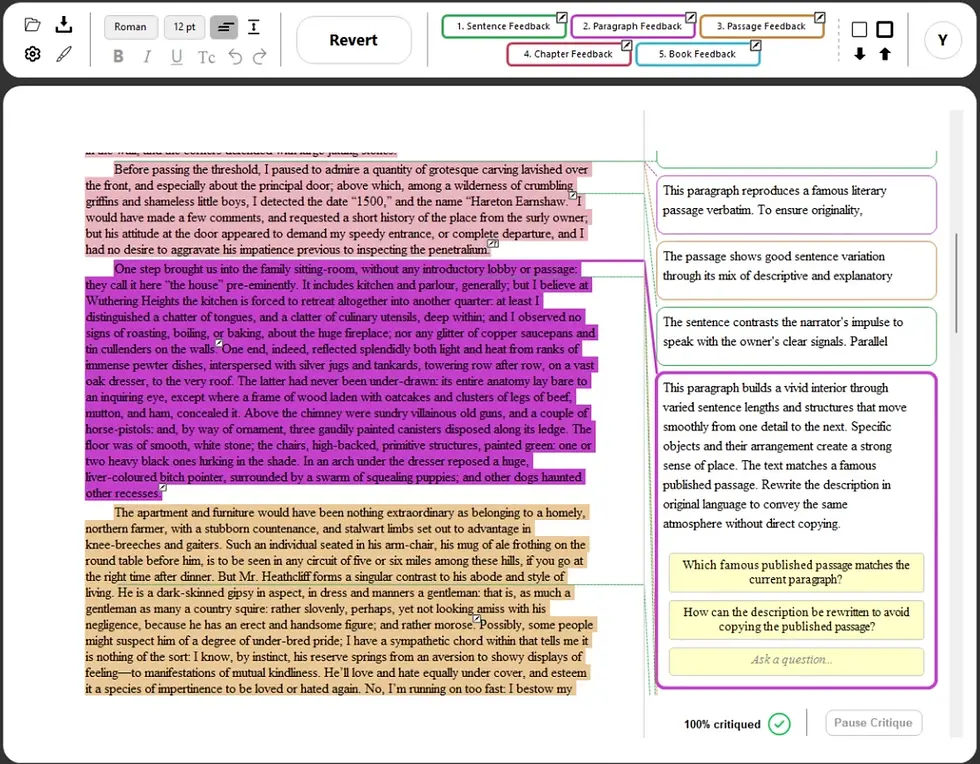
The sentence is the floor. The paragraph is the room.
Sentence-level edits miss what AI Book Editor catches at the paragraph level because they were trained on a different question. They police the line. Paragraph-level critique has to read the line as part of a block: takeoff, development, landing, and the job that group of sentences is supposed to do before the next break.
If a chapter is already “clean” at the level of the sentence and still feels weak, the problem is usually not another comma. It is a sequence of legal sentences whose grouping is hiding the change—or repeating it. Leave those paragraphs unexamined, and the manuscript will go out looking finished to a line editor and unfinished to a reader.
Passage, chapter, and book notes will ask whether the scene turns, whether the chapter holds, and whether the manuscript keeps its promise. Those are later altitudes. The next question after the sentence is the paragraph. It is also the question most drafts skip.

Comments